


A few weeks ago, a post appeared on my Instagram about the film “If Pigeons Turned to Gold,” (original title: Kdyby se holubi promenili ve zlato) in which I read that the Czech director, Pepa Lubojacki, spent several years documenting the story of her brother, who has alcohol addiction and is unhoused. My initial reaction was one of inner discomfort, and I think I judged the director. I thought I would never make such a film and that I would find a way to save my brother if he ended up on the street. Then I went to Prague and saw the film.
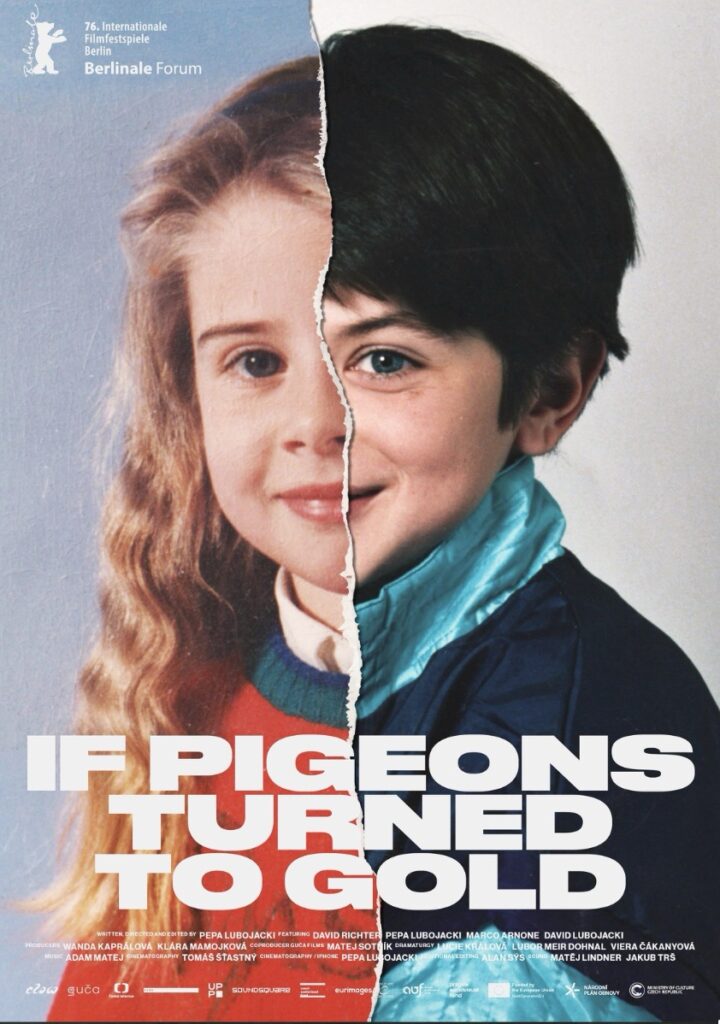
The film is a collage of techniques and images: video fragments shot on iPhone, animated photographs from the family archive, and a pigeon with Pepa’s eyes and lips, which moves through the film as a character in its own right. The structure is that of an intimate diary, narrated with brutal honesty, in which Pepa follows the cycle of addiction and the way she negotiates her relationship with David, her brother, who has been living on the street for eight years.
This negotiation is marked by several tensions. One is between the fear of losing him, the fear of her brother’s death in the present, and the mourning for the brother he was before addiction. Then there is the struggle between the social shame of talking about the situation and the personal shame of having a somewhat better life.
Throughout the film, Pepa shares deep concern and talks to her brother about his future: getting off the streets, finding a job, and so on. On several occasions she pays his rent, but each attempt at rescue fails, and with them the myth of the savior collapses. Faced with a complex social problem like addiction and homelessness, care becomes individualized, a responsibility borne by the family alone. The state, and any social support mechanism beyond the family, is entirely absent from the film.
The film deconstructs addiction as a failure of willpower or an individual moral failure, and the director arrives at a radical acceptance of her brother as being more than his addiction, as being enough and whole.
Because of its brutally honest approach, the film does not focus exclusively on the brother’s addiction. Pepa becomes a protagonist herself, speaking openly about her own addictions, and in doing so the documentary avoids reproducing the classic power dynamic between filmmaker and subject. The protagonists are not only David and the cousins in the present, people who live with addiction and have no shelter, but also their past selves: the children they were before addiction, who appear in animated childhood photographs and recount their experiences from that time. The resulting structure is non-linear, and the animated childhood photograph of David illustrates with precision the cycle of addiction and its connection to trauma.
I expected a documentary about addiction to tell a familiar and predictable story, and for the most part it did, but not in the way I expected. The predictable story is the one in which people without homes live not only on the margins of society but are also erased from their own families’ histories, becoming a source of shame and failure. The familiar one is the story in which a relative with an addiction, living on the street, is never mentioned at holidays. This film does not follow that script.
David does indeed live on the margins of society and, like many people in his situation, he is rendered invisible, unwanted, and dehumanized. At one point in the film, Pepa says she cannot get used to how invisible she becomes when she spends time with her brother, and that she cannot imagine what it would do to her to be invisible all the time. The remark suggests that dehumanization shapes a person’s sense of self and dignity.
The relationship between Pepa and David has been transformed by addiction, but it has not been erased. Their worlds coexist, and each remains part of the other’s life, in everyday moments as well as on holidays. We see Pepa visiting her brother where he lives, drinking coffee with him under an umbrella in front of a makeshift shelter (later demolished), bringing him food cooked by their mother, and searching for him in the abandoned buildings where he has stayed. We see Pepa decorating a gazebo in the park and organizing a picnic for their cousin’s birthday, David finding paintings on the street and giving them to Pepa, and the two of them celebrating New Year together at her home.
The film proposes an expansion of our capacity for empathy, an invitation to look at people who are unhoused and people living with addiction the way Pepa looks at David. But the film was also a process for Pepa herself, one through which she healed her relationship with her brother, a process through which she tried to see him beyond the lens of addiction, reimagined their bond beyond her role as savior, declared her unconditional love for him, and came to see him in all his human complexity.
The talking pigeon is a protagonist because the attitude toward pigeons in cities mirrors the attitude toward homeless people: they are perceived as a threat, as undesirable, and cities try, at all costs, to drive them away.
I gathered a gallery of photographs from the cities I visited, showing spikes on rooftops, spikes along the windows of designer stores, spikes on street signs, on churches and cathedrals. I was indignant, even furious. Why do we hate pigeons so much? Why do cities go to such lengths to make their lives harder? Why do they stop them from building nests? Why do we want to drive pigeons out of our cities at all?
Then I discovered that it had not always been like this. In Europe, pigeons have been domesticated for thousands of years and exploited by humans for many purposes: as food, as messengers in times of peace and war, as decoration for weddings and celebrations, as entertainment, and as the objects of bets in pigeon races. Once they became obsolete, they were abandoned on city streets and then driven away through various forms of hostile architecture, such as the spikes installed on tree branches in Bristol or on the roof of the Metropolitan Cathedral in Chișinău.
Then I discovered that there is no single history of the relationship between pigeons and humans. In the Isfahan region of Iran, for example, the architecture was so pigeon-friendly that entire towers were built just for them, with a diameter of up to 20 meters and a height of up to 15 meters. The towers housed semi-domesticated pigeons whose droppings (guano) were collected and used as agricultural fertilizer.
Conclusion
Through its collage of techniques, the film builds a non-linear structure in which addiction is neither the cause nor the summation of a life, but one moment in a broader biography marked by trauma and social dehumanization. The director’s brutal honesty, in which she owns both her addictions and her shame, destabilizes the hierarchy between filmmaker and subject, and her renunciation of the savior role gives rise to an unconditional love that does not demand that the situation be resolved. The parallel with pigeons suggests that the exclusion of people with addictions and of people who are homeless is a historical and cultural construction. Just as the relationship between humans and pigeons has taken radically different forms, from the towers of Isfahan to the spikes of contemporary European cities, the marginalization of people who are unhoused or living with addiction is not a natural state but the result of certain social choices, and can therefore be imagined differently.
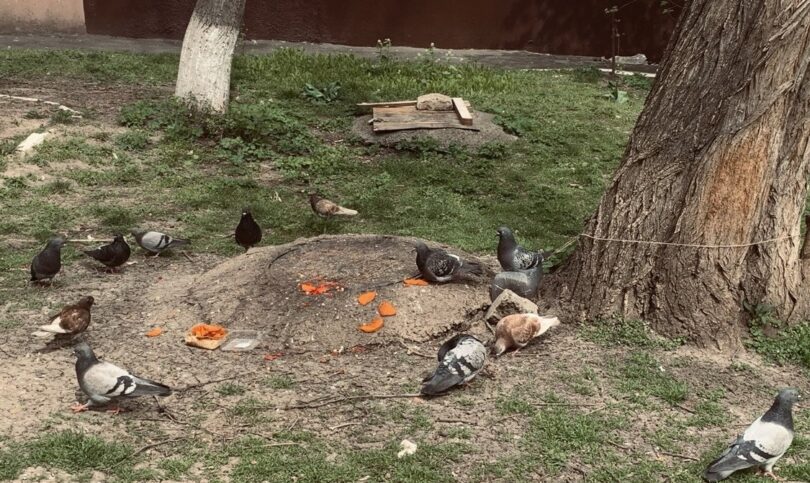
Featured image: Pigeons in Chișinău, photo by the author.