


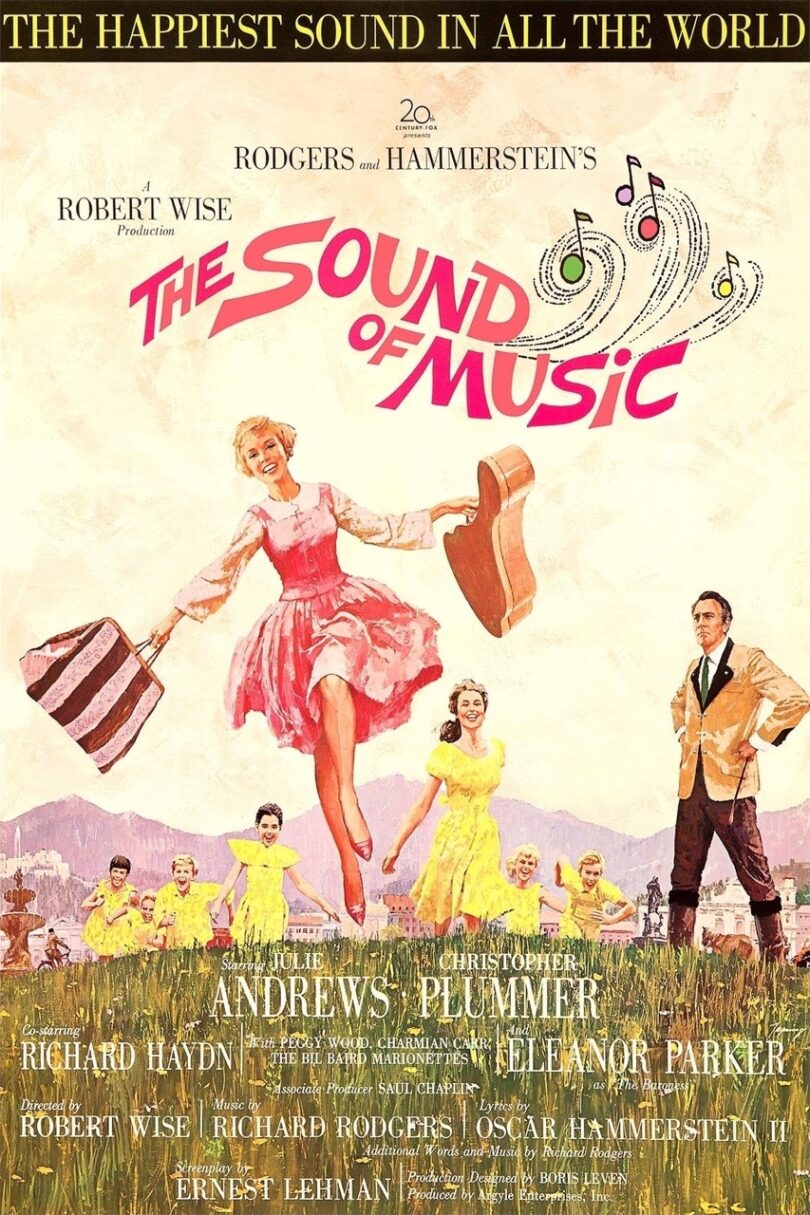

The Sound of Timeless Political Engagement
My partner and I sat down to watch The Sound of Music, the 1965 classic American musical. The film features Julie Andrews in the role of Maria, intrepid nun taking care of Captain Von Trapp’s seven children. In some ways, I forced the film onto him. I asked if he had seen it. When his answer was, “I think so, it’s kind of cheesy right?” I knew I had to right this wrong. “I don’t think so,” I said, “it involves Nazis,” which was all he needed to hear to confirm it was worth his time. I wasn’t the only person pushing the film onto my partner that evening. I wrote to a friend to see if her partner, also not American-born, had seen it. He likewise was in the dark, and worse, didn’t care for these American ladies enforcing their culture upon their “uncivilized” husbands. But in the end, they were both impressed with the film. And why wouldn’t they be? Broad, sweeping landscapes; triumph over fascism and a rallying cry to embrace, nay defend, the principles of freedom in our society. There was no surprise that the film resonated with me, on what is likely my 91st viewing, as well as with my partner on his first. The magic is in the timeless resonance of the film’s political engagement.
What we have in The Sound of Music is a beautiful and subtle tale of protest. It features a family of privilege and means. Their vast estate is complete with gardens and gazebos where young lovers meet and kiss, fruit trees where children climb and dangle, and terraces where adults drink spiked lemonade waited on by staff. This is not the angry, scrawny, outcast activist that we see in the streets of modern protests. This family comes from Salzburg and the upper echelons of society. We are wined and dined by their family dinners in formal dress and their ball thrown for the Baroness visiting from Vienna. We are also wooed by the lyrical music, cream-colored buildings and carriage rides. The result is transcendence from our current lives. We become part of this European fairy-tale, identifying with the commoner who rises above her station and integrates into this life of luxury. A drexszam one could only aspire to. That is, until the burning red color of the Third Reich arrives. The second half of the film shows the town seized by the Anschluss, the previously perfect buildings now covered in the dark stain of the swastika. Our dream, disrupted. But we also see a family who will not abide by the new rules. The Captain Von Trapp is ordered to join the navy of the Third Reich and rather than succumbing to this fate, he escapes with his family to Switzerland the same night. As the family walks over the Alpes to the tune of Climb Every Mountain, we are somehow beaming with pride. But why?
The Von Trap family makes us all feel like protest is possible and transformative. We have the impression at the end of the film that the family not only escapes the Third Reich but also defeats evil itself in the process. And in some ways, that’s not an inaccurate statement. Every time one stands-up to injustice, a small part of fascism dies. But in reality, all the Von Trapps did was to escape, protecting their own family, did it really right the wrongs of the Nazis? No, but their act shows that compliance and acquiescence is not the only option. Furthermore, they make it look easy. Sure, there’s a nail-biting chase through the streets and abbey and a kind of sadness when they talk about leaving their home and country, but in the end the children are walking through fields of flowers on their route to Switzerland, sun shining on their way. They’ve done it! Not only protested the Third Reich’s takeover of Austria but somehow brought down the dark powers of fascism. And importantly, as we unconsciously insert ourselves into this fairy-tale, their success becomes our success – one that’s achievable from the comfort of our own sofa. We ourselves have triumphed over fascism. No further action required – our work here is done.
When there are modern-day Von Trapps crossing the Polish-Belarussian border by foot, too often we are not cheering them. We sit idle as the Border Guards push them back into the forest forcing them to freeze to death. When there are men in Ukraine and Russia who choose (or wish) not to join the military and fight in the current war, they are not heralded for their courage and heroism. When there are protests in the United States against the harsh immigration crackdowns for people seeking to build a new life, we sit at home assuming activism is someone else’s job. In some ways, The Sound of Music makes us feel like our act of defeating fascism is already done, but the true power of the film is its reminder that we all have a role to play. No matter our position, our luxury, we have a duty to stand-up and it is possible and even transformative to do so.
That’s also what makes the film so iconically American – its portrayal of key American values. Set in the time of World War II Europe, the film’s content is not very American, but something else has enshrined it into American culture. For decades, The Sound of Music was shown on network television in the days after Christmas. Families sat down and watched it together year after year, a routine so common that my friend now refers to The Sound of Music as a “Christmas movie” although there’s no Santa, trees, or even winter. Interestingly, The Sound of Music provides an anti-war message of independence in contrast to the pro-military message of another classic American musical, White Christmas. And it is why we American wives insisted that our foreign-born partners see it – because this sense of agency and independence is fundamental to our culture. We want our homes, even abroad, to be imbued by the American spirit of speaking truth to power, exercising our voice, and standing-up for principles of freedom even with the system is shifting in a different direction. While I am not a nationalist and do not embrace the strong Austrian nationalist message in the film, in this case, being “Austrian” is less about borders and identities as it is about principles against fascism. In the same way, we are trying to enculturate our families with certain American classics not because they are essentials to being “American” but because they are critical to our value-systems. We want our families to quietly hum “Climb Every Mountain” because we’re hopeful that it will inspire them, inspire us all, to live a life of principle. It doesn’t matter that The Sound of Music came out in the 1960s, a time a deep political engagement in the U.S., or that we’re watching it today. Its message of political engagement resonates across generations. No matter our comfort, we can and should stand-up to injustice; it is both possible and transformative. Or as the film teaches us, “climb every mountain, ford every stream; follow every rainbow, till we find our dream.”
Background image: wikipedia







[…] Versiunea în limba engleză a cronicii […]