


In the realm of ecology and nature preservation, the history of the Soviet Union presents series of ironies and paradoxes.
On one hand, considering the aftermath of the Chernobyl nuclear disaster, the evaporation of the Aral Sea, the industrial development of Lake Baikal, the thousands of small rivers that were closed into ponds or were polluted by thousands of farms for the animal-industrial complex, all suggests a frightening image of human interventions in nature that often disregarded the needs of the environment and sometimes even sacrificed it in the name of ideological or economic interests.
On the other hand, the late USSR made pioneering efforts in climate change and biosphere protection. The environmental discussions of the late 1980s were so intense and involved such broad popular participation that some have called them an „environmental revolution”.
Overall, the ecological balance of the Soviet period therefore remains ambivalent, to say the least.
The assessment of the impact on nature by various agricultural, industrial, and infrastructural projects of Soviet socialism remains, in post-soviet countries such as Moldova, captive to biased ideological interpretations that tend to lean in one direction, either criticizing the system or praising it.
The few nuanced approaches highlight the fact that the Soviet man’s claim and arrogance to master nature are by no means unique to the Soviet system. On the contrary, the control over nature, almost blind faith in science and its ability to subordinate nature, and the presence of authoritarian political systems willing to ignore ecological arguments in favour of other interests (political, ideological, prestige) are common features of many countries in the 19th and 20th centuries, or even, it would seem, a feature of European modernity itself1.
From this point of view, the gargantuan infrastructure projects of the USSR, such as the diversion of the Siberian rivers Ob and Irtash from Siberia to Central Asia2, or the project to build a Danube-Dnipro canal, share more similarities withprojects such as the construction of the Panama or Suez Canal than differences.
In this article, I will tell the story of one such grandiose project of nature transformation– the Yalpug-Taraclia canal, built in the 1970s and 1980s.
The canal was intended to fulfill important economic functions – first and foremost to provide water from the Danube for irrigating the dry Bugeac steppe.
However, following its inauguration with much fanfare in 1984, it was found that the water transported from Yalpug could not be used for its intended purpose of irrigation due to its excessive mineralization.
The construction of the century, as the media of the time called it, ultimately proved to be futile.
In this article, I recount the economic, cultural, ecological, and social history of the canal.
Preamble
Research on ecological movements during the Soviet period remains underdeveloped, and in Moldova,it is virtually non-existent.
The environmental movement in the Moldovan SSR (and in the USSR as a whole) has been around since the 1960s, through an informal alliance of technocratic professionals (engineers, scientists) and cultural elites (particularly writers and journalists).
Ecological criticism served as a sort of „little corner of freedom of expression3” in the USSR, representing a proto-civil society that, while fragile and small, was very vocal.
For instance, the Writers’ Union of Moldova established an ecology department by at least the mid-1970s.
Gheorghe Malarciuc, the department’s head, extensively published on environmental issues, both in local press and union press, which was sometimesmore willing to include articles critical about the system.
Other important names – Ion Druță, Ion Dediu, Kapitolina Kozhevnikova – wrote extensively, even in the most repressive moments of the Bodiul era4, about the failure of the „Memory of Ilyich” orchard project on the left bank of the Dniester (rom. Nistru, rus. Днестр), about the pollution of small rivers, about the excessive use of mineral fertilizers and soil degradation etc.
Soviet ecological criticism provided themes and infrastructure for the social and political mobilization during the Perestroika.
In the Moldovan SSR, one of the founding moments that generated the so-called National Revival Movement, with a polemical article written by Ion Druță, „Land, water and commas” (rom. Pămîntul, apa și virgulele)5. Alongside the national language issue (the national theme), the problems of soil and water were also widely discussed.
Almost everywhere in the USSR during Perestroika, a general feature of political democratization movements was this fusion of the ecological theme and nationalist mobilization, a phenomenon known in the literature as „eco-nationalism6” .
Ecological themes grabbed headlines during Perestroika as press censorship was relaxed and restrictions were lifted. After 1986, the environmental criticism, which had been a discreet niche, became mainstream.
Environmental issues played an important role in mobilizing ordinary citizens, part of the technocratic elite (biologists, ecologists, engineers, and doctors), the cultural world (writers, artists) and part of the political nomenklatura. Together these groups formed important social movements that later evolved into so-called Popular Fronts7.
At the same time, the paradox of environmental activism in the late years of the USSR is that nowhere after the collapse of the Soviet Union did it create a strong environmental party that would come to power. In the post-Soviet space, environmentalism never became a real political force and has existed mainly as a social movement.
Irrigation is the path to abundance…
The development of the economy in general, and agriculture in particular, was one of the basic pillars of the Soviet state.
Caught between the economic reality of permanent competition with the capitalist system (from which it bought at times various technologies and industrial equipment in exchange for agricultural production), the political solidarity of providing aid (including food aid) to various allies and satellites around the world, and the ideological promise of the constant and imminent rise in the living standards of the people, the Soviet state was forced to seek solutions to increase the productivity of agriculture and increase the production of agricultural products.
After Stalin’s death in 1953, the authorities saw the solution in the expansion of cultivated areas. This was done by integrating previously unused grasslands of northern Kazakhstan and the Altai region during the so-called campaign of reclamation of the Virgin Lands (rus.Освоение целины)8 also known as tselina.
This initiative aimed to open an area of 13 million hectares to wheat production.
However, the integration of tselina into the agricultural circuit did not bring the expected results, with harvests remaining far below expectations. Therefore, the authorities feverishly sought other solutions in the 1960s.
As the possibilities of extensive agriculture seemed exhausted — after the exploitation of tselina, the USSR had no new fertile land to bring into the circuit — the authorities had to pursue agricultural intensification, i.e. increasing agricultural production by exploiting existing agricultural land more intensively.
Irrigation, along with mechanization (the widespread use of agricultural machinery) and chemization (the extensive use of chemical fertilizers and pesticides) was a promising avenue.
So it became the main focus of the Party’s attention and efforts.
The decisive moment in the campaign to build massive irrigation systems was the May 1966 Plenary Meeting of the Central Committee of the Communist Party of the Soviet Union (CPSU), which adopted the decision “On the widespread development of land improvement to produce large and stable yields of grain and other agricultural crops“9.
The decision employed a clear productivist logic and aimed at “increasing by any means the yield of each hectare of land.”
The new irrigation campaign, as Leonid Brezhnev, the CPSU General Secretary, described it, ”is not an ephemeral campaign, but a long-term programme, one that is crucial for the Soviet state”.
The party was ready to allocate colossal material resources to achieve the campaign’s aims. The document stipulated that within 10 years, the area of irrigated land throughout the USSR would be increased by 7-8 million hectares.
The decision laid down the general guidelines for the development of Soviet agriculture through the widespread use of irrigation.
The irrigation was already used in the USSR, mainly in cotton production. However, from 1966 onward, the Soviet state wanted to extend its use also to grain, maize, wheat and rice production. “We must proceed boldly and resolutely in the development of irrigated grain farming“, Leonid Brezhnev famously declared at the same plenary session.
Irrigation, thus, became one of the main tasks of the Soviet economy.
The party organs and Soviet science were to mobilize to design and build large irrigation systems in order to achieve this ambitious goal.
By the 1980s, several extremely ambitious irrigation projects were drawn up.
For example, in the European part of the USSR, in the southern part of Ukraine and Moldova, irrigation was to be carried out using the waters of the Danube, which would irrigate more than 330,000 hectares of dry land. Several canals — Danube-Yalpug-Taraclia, Danube-Cahul-Nisporeni, Danube-Dnieper — whose construction horizon extended up to 2020, would have transferred Danube water to the dry steppe areas of Ukraine and Moldova .
Another more grandiose project aimed, no less, at diverting Siberian rivers from the north and east to the south. With 82% of the Siberian rivers’ flow carried to the frozen Northern Ocean and Pacific Ocean basins, Soviet planners proposed diverting the rivers so that their water would flow south to warmer but drier parts of the USSR10.
In Moldova, irrigation was already applied but on a very small scale.
Things were to change dramatically in the coming decades.
After the May 1966 plenary session, Gherman Afteniuc, Minister of Water and Land Improvement of the Moldovan SSR, was full of hopes about the future of irrigation in the republic. “The practice of many years shows that, under Moldovan conditions, there is no agricultural crop which, being irrigated, does not give the expected effect…By 1970 in the republic every tenth hectare will be irrigated, and in the future — every third hectare of arable land.”
| Note: In Moldova, large-scale irrigation began to develop massively after 1924 in the Moldavian Autonomous Soviet Socialist Republic and, after 1944, on the right bank of the Dniester. By 1940 in the RASSM, on the upper terrace of the Dniester river, the Caragash irrigation system was built, with an irrigable area of 5700 hectares . After 1944, also on the Dniester, two other large irrigation systems were built: at Sucleia and Rîbnița. Until the mid-1960s, the irrigation network in the Prut valley remained modest. In total, between 1946 and 1966 the irrigated areas increased more than 16 times: from 5.5 thousand hectares to 88.7 thousand hectares. |
The characteristics of the Moldovan SSR in the USSR economy can be summarized as follows: specialization and concentration of agricultural production, achieved through a high degree of agricultural exploitation of the territory.
Plowed land occupied about 87% of the republic’s area, in other words, the country had no land reserves. Despite its small territory, the Moldovan SSR held an important place in USSR agriculture.Thus, in the overall production of tobacco, the Moldovan SSR accounted for 35-38%, grapes constituted 20-25%, fruit — 10-12%, sugar beet and vegetables — 3-4%11.
Once irrigation was declared a priority by the party and state leadership, it began to develop rapidly, including in Moldova.
In May 1965, a specialized institute for the design of hydro-improvement works (irrigation and desiccation) — “Moldhidroprovodhoz12” — was established. In November of the same year, a specialized ministry — the Ministry of Water and Land Development was also created. At the “M. V. Frunze” Agricultural Institute (currently Agrarian University), a specialized faculty was established to train specialists and conduct research in the field.
A new impetus for the development of irrigation systems came from the USSR Food Programme until 1990, which was adopted in 1982. According to it, large farms specializing in vegetable growing were to be organized in the Moldovan SSR to supply other areas of the USSR with vegetables13.
The Food Programme also stipulated that at least 240 thousand hectares of irrigable land should be put into use by 1990.
Another programme drawn up by the republican authorities in the mid-1980s promised even more widespread use of the Danube’s waters for irrigation in the future.
“In the more distant future it will be necessary to resort to transferring part of the Danube water north, towards the center of Moldova. The Academy of Sciences of the Moldovan SSR was tasked with drawing up an ecological basis for the water transfer project by 199014.”
Most of the irrigation systems built in the MSSR — Grigoriopol, Suvorov (Ștefan Vodă), Caușeni, Cărpineni, Cahul — were designed by “Moldhidroprovodhoz”.
Bringing water uphill towards Taraclia, or How we prepare to satisfy the thirst of Bugeac
The project for the construction of the Taraclia irrigation system, the largest in the Moldovan SSR, was developed by engineers S. Kirillovich, V. Irincin and V. Filippov of “Moldhidroprovodhoz”.
The production association “Iugvodstroi” (based in Taraclia) was set up in order to build it.
The inauguration was planned for 1984, on the occasion of the 60th anniversary of the formation of the Moldovan SSR and the creation of the Communist Party of Moldova.
According to the plan, the irrigation system was to extend from the northern shore of Lake Yalpug, near Danube, to Taraclia.
The system included the Taraclia artificial lake (with an area of almost 2000 hectares and capable of holding up to 70 million cubic meters of water) and a 30 km long water transport canal. The depth of the canal reached 10 meters in places and its width at the top reached 110 meters. Several pumping stations have been built along the canal in order to push the water uphill15.
In the media of that time, journalists described the functioning of the canal as follows: the canal would bring water from Lake Yalpug and then, “as the water receded, the lake would fill with water from the Danube, which would flow through the Repida arm, linking Yalpug on its southern side with the Danube“16.
In other words, Lake Yalpug was to be transformed into an “antechamber” through which the water of the Danube would pass and then continue its way to Comrat, Taraclia and Ciadir-Lunga.
The canal had the capacity to carry five times more water than the Prut river17!
The irrigation system using the water from the Danube would ensure the irrigation of more than 170 thousand hectares of agricultural land.
In 1983, Vitalie Olexici, the Moldovan SSR’s Minister of Water and Land Improvement, estimated that the net profit would be over 400 million roubles (i.e. 6-7% of the republic’s GDP)18.
The Taraclia irrigation system was of particular significance to the republican authorities, who declared its construction a shock construction site.
This meant that the party and other public bodies of the MSSR and the whole of the USSR were required to mobilize and send Comsomolites to the Taraclia site.
According to the media, more than 3,000 builders, mostly from the MSSR, worked on the construction of the irrigation system. More than 500 bulldozers, trucks and tractors were involved and they ended up excavating and moving more than 7 million cubic meters of soil.
On the construction site
The performative aspect of work in Soviet socialism is well documented19. Construction projects, especially those of all-Union significance (shock construction sites) not only transform nature (by changing riverbeds, digging tunnels in mountains or clearing forests), erect factories and towns in the wilderness or taiga, but also serve political functions.
First, for the Party, these are convincing proofs of the superiority of the socialist way of life and mode of production over capitalism. In the competition between the two economic systems, every completed project works also as an argument in favor of socialism.
Secondly, labor occupies a central place in the construction of the new Man, the Soviet citizen. “The poetry of work… Can there be anything more uplifting and wonderful in human life?” wonders a Soviet social science textbook for school students20. In capitalism, the same textbook continues, exploitation kills the joy of work. Only in socialism does work become free and turn into creation. Socialism, according to the textbook’s authors, “opened the door to heroic deeds in the main area of human life — in work. (…) The communist attitude to work — this is the true source of revolutionary romanticism.21“
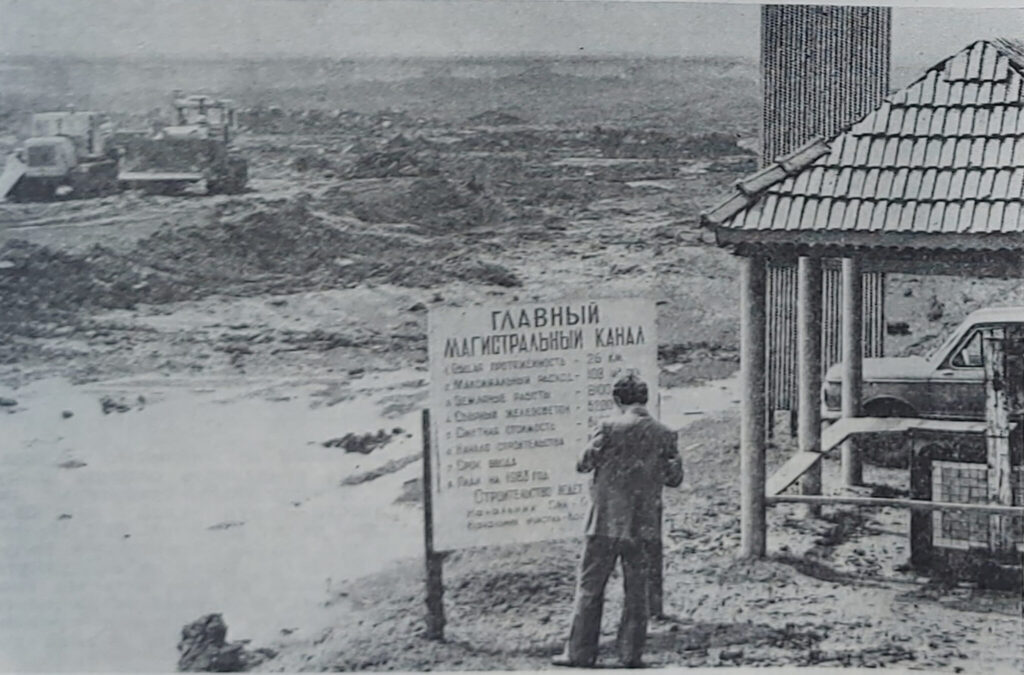
For these reasons, construction sites also became important public places: they were regularly visited by various party and ministry representatives who checked on the progress of the work.
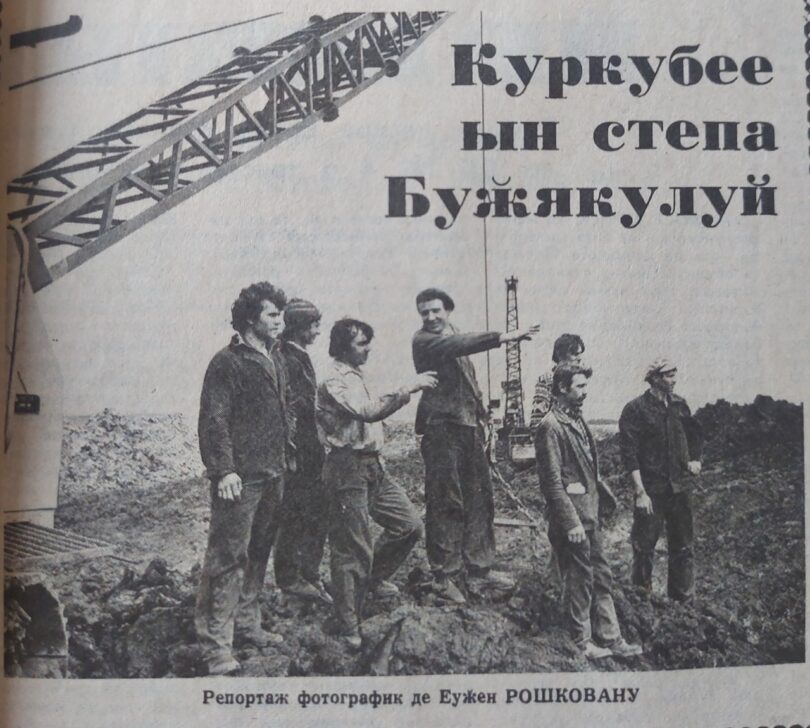
The media — local, republican and even central newspapers — regularly hosted materials — texts, photographs, literary portraits, interviews — from the construction site.
As a shock construction site and one of the most important infrastructure objects under construction at the end of the 1970s and 1980s , the construction of the Taraclia irrigation system received a lot of attention from the local and republican authorities and press. Reports about the construction site even appeared in the central media such as Pravda and Izvestia newspapers.
The Taraclia construction site involved a large part of the republic’s industry in the process. A plant in Tighina (Bender) produced large-diameter concrete pipes. The “Remzemmash” plant in Tiraspol repaired earth-moving machinery, and “Avtopoliv” was responsible for large-scale equipment for installation at already assembled pumping stations.
The area also became an important propaganda venue — foreign delegations arriving in Chișinău visited Taraclia to learn about the advantages of the socialist way of life and the achievements of the Soviet economy and society.
Thus, a photographic report published in 1983 in the magazine Nistru tells of a visit to the construction site of a delegation from the Scientific Research Institute for Irrigation and Drainage in Havana, Cuba. The delegation highly praised the achievements of Moldovan construction workers22.
Between 1982 and 1984, the Taraclia district newspaper, The Light of October (rom. Lumina lui Octombrie), regularly published text and photographic reports from the construction site, as well as reports from the district party council meetings on the topic of the construction.These materials were later picked up by other regional newspapers.
The central media of the republic also generously covered the from Taraclia. The most important newspapers — Tinerimea Moldovei, Moldova Socialistă, Literatura și Arta, some specialized magazines — Agricultura Moldovei, for example — sent entire teams to report from the spot and describe enthusiastically the “great construction site” and its heroes.
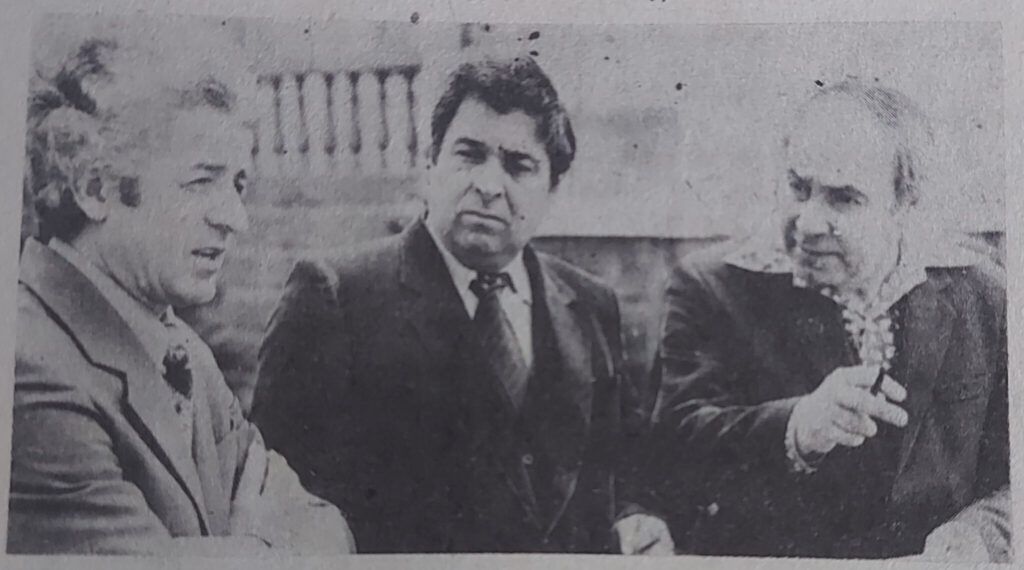
The site was also frequently visited by writers who popularized the construction work by writing sketches, reports and literary portraits of the workers and groups of workers. “The alliance of pen and work” — this is how the Taraclia district newspaper, Lumina lui Octombrie, described a visit of a delegation from the Writers’ Union of Moldova and the literary magazine Nistru in the spring of 1984. The delegation included the magazine’s editor, poet Arhip Cibotaru, writers Vladimir Beșleagă, Nicolai Baboglu, Victor Prohin, Ion Gherman, and poets Iulian Nicuță, Ion Vieru and Stepan Kuroglo23.
During this visit, the magazine’s administration agreed with the local authorities on a plan for Nistru to become a patron of the canal.
The journal of the Union of Writers, Nistru, thus became a literary patron of the Taraclia construction site. Between 1983 and 1985, Nistru hosted dozens of articles — photographs, poems, interviews, reports from the site — which regularly recounted the progress of the work and helped create the mythology of the project.
Writers from Nistru described, in the most vivid colors, the daily work of the workers, of the excavators, dumper trucks, social and food service workers, and district and party governing bodies.
Metaphors such as “the artery of life” or “the hope of Bugeac” frequently appeared in their writings.
The metaphorical opposition life (the construction site) and death (the uncultivated steppe) was also often used by writers and journalists.
“Where three years ago you would have seen a barren, wild land, eaten by salt marshes, strewn with sedge, thistle and wormwood (…) now stretches a true sea.24”
For these writers, the wilderness was death and the water symbolized life.
Reports from the site anthropomorphized the steppe land, describing it as dry and thirsty. Because of this, the irrigation system would “quench the thirst of the Bugeac25.”
In the media, irrigation is described as a synthesis of the Leninist idea of constant renewal of society and physical rejuvenation of the land.
Some visitors to the site describe its construction as an epochal moment.
In the words of the writer Gheorghe Gheorghiu, the construction of the canal heralds a new era, the Time of the Waters, following the Time of the Book initiated in 1944 with the general literacy campaigns, and the Time of Light inaugurated in the 1960s with the construction of the Dubasari hydroelectric plant26.
Another of Gheorghe Gheorghiu’s characters, the forester Vasile Moraru, speaks of a new era that transforms myth into immediate reality makingstories encountered only in fairy tales an everyday occurrence.
“There are many proverbs about the Danube. For example: to return from somewhere in a time when the Danube turns back, i.e. never. Now, if the Danube-Nisporeni canal will be built, the water will flow through the new riverbed, really backwards, towards the north, and then what do you do with this proverb?“
The Taraclia construction site becomes a metaphor for the process of transformation and control of nature by the new, socialist man.
“Socialist man,” wrote Lev Trotsky, one of the founders of the Soviet state, “wants and can control nature in all its fullness.(…) He will show the mountains where they should stand and where they should make room for man27.”
In the words of Gheorghe Gheorghiu, after the construction of the irrigation system, the people of Taraclia (and Moldova) will be able to control the rain as they please. “Now we can have the rains at our command. Yes, yes, it will rain really when we want it.28”
The construction site is, of course, a struggle—a battle for water, a fight for life. The work at the site is often being described as a front, and the industriousness of the workers—as an act of heroism.
The writer Viorel Mihail, in a report from the summer of 1984, makes extensive use of war metaphors: “Hundreds of diggers, about thirty in number, with arms crossed like swords, were digging their muzzles into the oily clay. The struggle for water, for that is the ultimate goal of the work here, was in full swing29.”
The metaphor of a battle is also used by the writer Nicolai Baboglu. The hero of his report tells how the collective he belongs to is fighting “a life-and-death battle, with the goal to retain water in the soil at all costs30” in drought conditions. The battle for water is part of a struggle for moisture and high yields.
Obviously, just as every battle ends in victory, the inauguration of the object in 1984 symbolizes the triumph in fight for water in the Bugeac.This victory is gained “with a high degree of conscientiousness, an expression of the impetus and total dedication in the name of the cause for which it was fought31.”
The construction site acts also as a school of civic education, perpetuating models of hardworking and dedicated people.
Those who come to the site are motivated by the “holy feeling of brotherhood, friendship and mutual help32”.
In the words of Viorel Mihail, “the worksite shapes characters”.
“The worksite matures man, makes the young man independent, self-sufficient, the worksite gives him freedom of action” .
The successful construction of the canal speaks of “the active position of our times”, being the fruit of a subtle interaction “when personal interests coincide with those of the whole collective.33“
And above all, the Communist Party oversees the construction, providing political patronage of the construction, or, in the language of the time, “the ideological insurance of the construction.”
The party’s role entails stimulating the industriousness of the workers, coordinating the processes, and dealing with the diverse problems and barriers that arise during construction—such as logistics, transportation, and feeding the workers, etc.
“In our work, we have always told the truth. At every meeting with workers, we spoke openly, without any evasions. We made it clear to them what the concrete tasks were, every day, in order to achieve the proposed objectives. That is why we also managed to keep our word, because we acted together“, says Vladimir Garaba, secretary of the Taraclia district committee of the Communist Party of Moldova34.
Just like any struggle, the Taraclia site has its heroes and even its families of heroes.
Many articles tell the story of the Barinov family — Nicolai and Eudochia — who, after having participated in the construction of the hydropower plant and the Costești-Stânca reservoir, “came to the call of their hearts to build the Taraclia water basin”.
The Barinov couple35, called by the author of the article a “family crew ” (their son would join the site at some point), performs 2.5-3 daily tasks of loading the earth, and through this, by personal example, they mobilize other people to work.
In fact, the Barinov family is one of the most beloved figures among journalists and writers who write about the canal.
Another hero, whose name has not been preserved, is a resident of Taraclia who declared his intention to host teams of workers in his house in case of need. “If housing for the builders is needed, I offer two furnished rooms for their use. Here, dear friends, we will live together36“.
The construction of the irrigation system was not only an ecological or economic transformation but also a cultural and social, and even civilisational one.
The future object transforms not only the nature around it but also the human community.
Just as, to use the words of a poet in a poem about the construction site, the past and present of nature are written in Taraclia, so too the yesterday and tomorrow of the city are being shaped here.
The future, says a headline of an article in the district gazette, begins today, and that can only be beautiful and romantic.
“To create with one’s own hands the history of the city — nothing could be more romantic37.”
The site has indeed generated a whole economic and social infrastructure around it. A few years earlier, in 1980, Taraclia had become a district center and acquired the status of a city.
From a small, poor town, Taraclia had become a veritable Babylon, an important regional center and one of the most important construction sites in the republic.
This dramatic transformation does not go unnoticed.
“Let’s hear how Taraclia remained in the memory of the older generation in the not-so-distant past:
— Low, reed-covered cottages, and in the center a low, shack-like building — the district center club — this is how Taraclia was seen by the inhabitant of the small town V. Bobriniov twenty-six years ago38.”
In the meantime, a 9-storey building for the headquarters of the “Yugvodstroi” association is being built in the town, along with other important industrial objects planned, including a car base for 700 cars, a brick factory with a planned output of 35 million bricks, and a cement pipe manufacturing plant39.
Important social and cultural infrastructure is also set to be built.
“A real dream”, describes one journalist when discussing the city’s development plan.
“Let us imagine for a moment a small, but clean, light and comfortable town — with beautiful five-storey and multi-storey buildings, bathing its blocks in a whole sea of greenery with wide streets, a market, resting parks, spacious cinemas, modern shops….In a word, this is a place that has all the achievements of the modern civilisation. And just outside the town, on the outskirts, the waters of the artificial lake, the beloved resting place of the citizens of Taraclia. (…) Is it a dream? Yes! But it is a real dream, more than that, it is the near future of Taraclia40.”
In another article, the author invites his audience to accompany him to an imaginary journey into the future, through the city of Taraclia in 1990 .
“Let’s take a stroll through the center, which is made up of three- and five-story buildings. These are the buildings of the party committee, the court, the local soviet council, the sanitary-epidemiological station (…) Your attention was drawn to the neighboring buildings? This is the center of cultural enlightenment with a concert hall for 850 seats, music school, library. Not far away is the museum, the Marriage Palace, and a little further on the Pioneers’ and Students’ Palace, the Young Technicians’ Station, a cinema for 600 seats (…) The sports complex and the summer cinema, the road for 800 seats are beautifully arranged41.”
Challenges and difficulties
The process of building an irrigation system was, of course, not without problems and difficulties.
As is often the case, even on major construction sites, coordinated by party at the highest level, the work was poorly organized, equipment, machinery and building materials did not arrive on time. People were not fed on time or were housed in poor conditions.
Among the constant problems of the site was the insufficient number of workers (in 1980, it was only 80% of what was needed) and the high turnover of personnel42.
Some reports also indicate inefficient organization of the work.
“How long can such an attitude be tolerated? People came to work and had nothing to do. At the morning column planning the chief engineer promised us a crane and a dump truck, but here it is noon already and the trucks are nowhere to be seen43“.
Even when there are enough men, their allocation to the items on the site is done haphazardly or not at all. “Because of the unpreparedness of the work front in our sector, a student detachment of 35 people was transferred to another object.”
Another material reported a similar problem — out of the 30 excavators that were supposed to work on the main canal, only 13 were involved.
Sometimes the specialized equipment was lacking. Thus, because the Lugvodstroi Association did not have a 25-tonne lifting crane, work on the pumping stations was also slowed down a lot.
The construction of other industrial and urban infrastructure objects of the project was also slow. A meeting of the district party committee held in the autumn of 1982 noted delays in the construction of sewage for enterprises and industrial organizations in the town of Taraclia. According to the meeting, the official plan stated that the works were to be finished in 2 years and 5 months. But they had already stretched over a period of 4 years and 7 months, and the end was not yet in sight. “Out of 20 machines necessary to carry out the work only 2-3 are working daily, out of 36 items of construction materials we have 3-4, out of 70 workers on the object work on average 20-30 people.44“
The district party committee also found that “the quality of construction work is very low. Because of this some of the construction and assembly work that has been carried out needs to be redone45.”
Despite these difficulties, the Taraclia irrigation system was inaugurated in September 1984.
The inauguration ceremony was attended by Semion Grosu, First Secretary of the Central Committee of the CPSU, Polad Polad-Zade, First Deputy Minister of Water and Land Improvement of the USSR, IonUstian, Chairman of the Soviet of Ministers of the Moldovan SSR.
…In December 1984, Alexandru Chișlari was appointed as a Minister of Water and Land Improvement of the Moldovan SSR. In his memoirs, he recounts that shortly after his appointment he was visited by V. Pominov, president of “Moldhidroprovodhoz”.
Pominov openly told the new minister “that the situation at the largest construction site in the republic was worrying. The water that was to be used for irrigation had high mineralization and was not suitable for irrigation. It was a shock.46 “
Chișlari went to Taraclia to see the situation for himself. His bewilderment knew no bounds.
The main canal was already functioning, and the Taraclia lake was already full of water, ready to distribute water through the irrigation system. Being salty, however, the water was harmful for irrigation and the presidents and agronomists of the surrounding collective farms refused to use the salty water for their lands.
It should be mentioned that the whole political context of the country has changed. The new general secretary, Mikhail Gorbachev, who came to the leadership of the Soviet party and state in March 1985, initiated a campaign against mystifications and unjustified increases and that gave to new officials like Chișlari the freedom to criticize the excesses of his predecessors.
Investigations by the new minister revealed several problems.
Firstly, the actual mineralisation of Lake Yalpug, the antechamber to the waters of the Danube, was not taken into account at the planning stage. The actual mineral and salt content in Yalpug turned out to be much higher than calculated in the project.
Moreover, the mineralisation process in Lake Yalpug intensified after 1970, when the project had already been adopted and the builders were using the old calculations.
In the autumn of 1985, an attempt was made to solve the problem by renewing the water in Lake Yalpug.
Thus, the lake was drained almost to a minimum level, and in 1986, during the spring floods in the Danube, the lake was filled again to a maximum level.
The attempt was in vain. The mineralisation level of the “new water” in Yalpug turned out to be at the previous level.
As a result, the irrigation system was officially abandoned.
Hundreds of millions of rubles and all the collective effort proved to be useless.
Epilogue
The traces of the “construction site of the century” are still visible today.
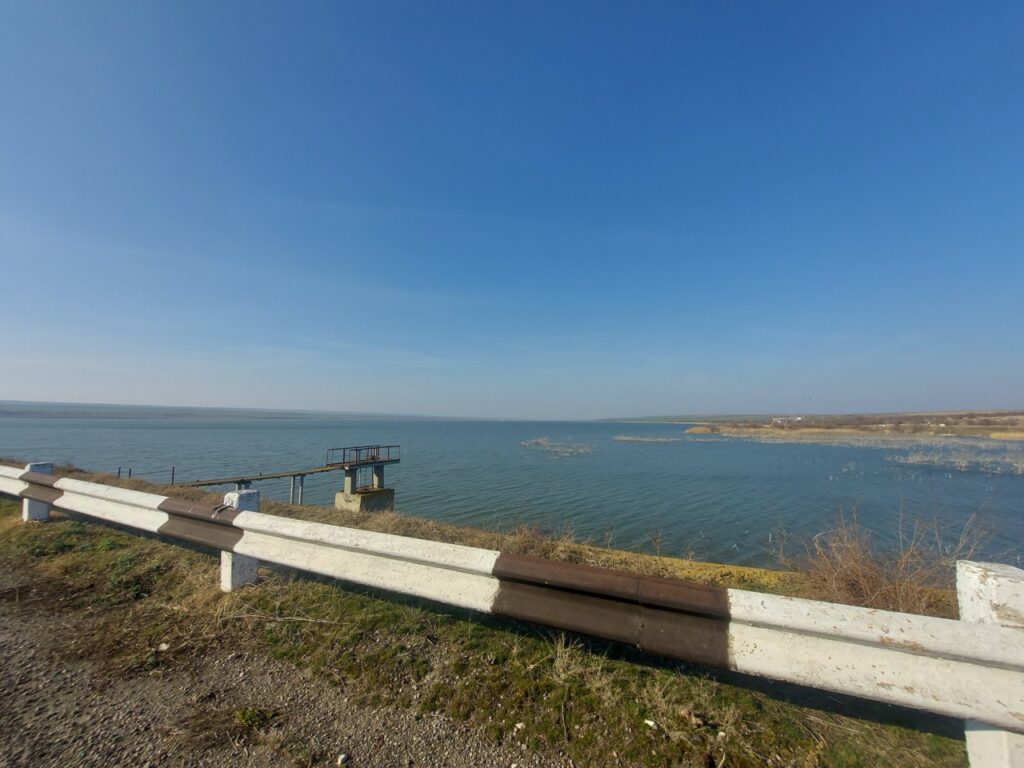
The Taraclia lake remains, although its surface area has somewhat decreased over time.
Along the road to the Mirnoe border crossing, the skeletons of pumping stations can still be seen.
However, nothing remains of the irrigation system that was supposed to quench the thirst of 170 000 hectares. At the end of the 1980s, the “Lugvodstroi” association complained that it was unable to guard the pumps and pipes scattered across several districts. The irrigation system was dismantled and… stolen, much likemany other objects of industrial infrastructure during that time.
From the ecological point of view, the project was almost a catastrophe.
The construction of the canal and reservoir, the experiments with emptying and filling Lake Yalpug — all these interventions in the steppe caused major and irreversible changes in the region’s flora and fauna, soils and waters.
The disaster could have been even greater if the irrigation authorities from Chișinău and Moscow had succeeded in forcing local party and kolkhozes to use this water for irrigation. Similar situations occured in the 1980s in Ukraine, near Lake Sasyk , where several thousand hectares were salinised in a similar experiment.
However, this outcome was avoided: after the Chernobyl disaster, Soviet society had become more skeptical about grandiose nature intervention projects.
Environmental risk, until then just a technical category, had become a tragic reality.
There is also another history of the ‘site of the century’, the social and cultural one, which is somewhat separate from the ecological one.
The balance of this history is more positive.
The Taraclia construction site was a major event for thousands of people who,driven bythe call of their hearts (and we have no reason to doubt their sincerity), went to work on the great construction. There, they worked for years and nights, in heat, rain, wind and snow, made friends, some even met their spouses.
They made their contribution.
The city of Taraclia itself owes much of its growth since the late 1980s to the construction site. While not all the infrastructure items have been completed. The city’s flourishing, expected after the inauguration of the main canal, never happened. However, this outcome was due to reasons originating far beyond Taraclia.
To draw a preliminary conclusion: the history of Lake Taraclia will always be marked by this profound ambivalence — on the one hand a natural disaster (which could have been avoided under certain conditions), yet built with dedication; and on the other hand, a social construction site which built a town, a lake, and educated thousands of people.
This article is part of a wider research project on the Taraclia canal and its ecological, cultural, social and collective memory aspects.
Future plans include interviews with the people who worked on the site, a photo exhibition in Taraclia and Chisinau, and a catalog of the project.
- For example: Scott, James C. 1999. Seeing like a State: How Certain Schemes to Improve the Human Condition Have Failed. 0 edition. Yale University Press. ↩︎
- See Bressler, Michael L. 1995. “Water Wars: Siberian Rivers, Central Asian Deserts, and the Structural Sources of a Policy Debate.” in Rediscovering Russia in Asia. Routledge, 1995, pp.240-255. ↩︎
- Weiner, Douglas R. 2002. A Little Corner of Freedom: Russian Nature Protection from Stalin to Gorbachev. ↩︎
- Bodiulism – from the name of Ivan Bodiul, who was the First Secretary of the Communist Party of Moldavian SSR from 28 May 1961 to 30 December 1980. His reign was marked, among other things, by authoritarianism. He came into conflict with the writer Ion Druță because of the perceived conservatism of the writings of Ion Druță. ↩︎
- Ion Druță. Pămîntul, apa și virgulele, în Scrieri, Vol. 4, Chișinău, Literatura Artistică, 1987. Link: https://rssm.platzforma.md/ион-друцэ-скриерь-ын-4-волуме/ ↩︎
- Dawson, Jane I. 1996. Eco-Nationalism: Anti-Nuclear Activism and National Identity in Russia, Lithuania, and Ukraine. Duke University Press ↩︎
- Popular Fronts – large coalition led mostly by the liberal intelligentsia that have appeared in most of the republics of USSR during the Perestroika, with the aim to defend the Perestroika (a series of reforms initiated by M. Gorbachev), which later opposed the Communist Party and provided the cadres for the new republics. ↩︎
- Gheorghe Cojocaru. Despre inițiativa valorificării pământurilor de țelină și pârloagă. Legătură: https://moldova.europalibera.org/a/despre-initiativa-valorificarii-pamanturilor-de-telina-si-parloaga/32848473.html ↩︎
- Moldova Socialistă, 29.05.1966. ↩︎
- Tolmazin, David. 1987. “Recent Changes in Soviet Water Management: Turnabout of the ‘Project of the Century.’” GeoJournal15(3):243–58. ↩︎
- V. G. Ungurean. Cu simț de răspundere în fața pămîntului. Interviu. Nistru, 1979, Nr.11, p.103 ↩︎
- История развития института «Аквапроект». Legătură: http://www.eecca-water.net/content/view/474/24/lang,russian/ ↩︎
- Продовольственная программа СССР на период до 1990 года. Одобрена 24 мая 1982 г. Пленумом Центрального Комитета КПСС. Link: https://docs.historyrussia.org/ru/nodes/347553-prodovolstvennaya-programma-sssr-na-period-do-1990-goda-odobrena-24-maya-1982-g-plenumom-tsentralnogo-komiteta-kpss-izlozhenie#mode/inspect/page/10/zoom/4 ↩︎
- Програмул комплекс пе термен лунг де протекцие а медиулуй ынконжурэтор ши де фолосире рационалэ а ресурселор натурале дин РСС Молдовеняскэ пе периоада де пынэ ын анул 2005. Кишинэу, Картя Молдовеняскэ, 1987, p.27. Link: https://rssm.platzforma.md/%d0%bf%d1%80%d0%be%d0%b3%d1%80%d0%b0%d0%bc%d1%83%d0%bb-%d0%ba%d0%be%d0%bc%d0%bf%d0%bb%d0%b5%d0%ba%d1%81-%d0%bf%d0%b5-%d1%82%d0%b5%d1%80%d0%bc%d0%b5%d0%bd-%d0%bb%d1%83%d0%bd%d0%b3-%d0%b4%d0%b5-%d0%bf/ ↩︎
- Apele Dunării în cîmpia Bugeacului, Tinerimea Moldovei, 3 octombrie, 1984. ↩︎
- Nistru” pe șantier. Apă-n deal la Taraclia sau cum ne pregătim să potolim setea Bugeacului, Nistru, 1973, Nr. 9. p. 77 ↩︎
- Și apa-n stepa din Bugeac veni-va, Nistru, 1983, Nr.12, p.106. ↩︎
- Idem, p.107 ↩︎
- One of the most comprehensive descriptions of the role of labor in Soviet socialism, as exemplified by the construction of the city of Magnitogorsk, can be found in Kotkin, Stephen. 1997. Magnetic Mountain: Stalinism as a Civilization ↩︎
- Științe Sociale. Manual pentru școala medie. Chișinău, Cartea Moldovenească, 1964, p.64. ↩︎
- Idem, pp.339-340. ↩︎
- Nistru, 1983, Nr, 12. ↩︎
- Alianța condeiului și muncii. Lumina lui Octombrie, 19.04.1984. ↩︎
- Vlad Berlinschii. Suișul și coborîșul apelor. Nistru, 1985, Nr. 9, p.115. ↩︎
- ”Nistru” pe șantier. Apă-n deal la Taraclia sau cum ne pregătim să potolim setea Bugeacului,Nistru, 1973, Nr. 9. p. 73 ↩︎
- Gheorghe Gheorghiu, Vremea apelor, Nistru, 1985, Nr. 2, p. 102. ↩︎
- Троцкий Л. Д. Литература и революция. Москва, Политиздат, 1991, с. 194. ↩︎
- Constantin Andreev. Croind apei cale de rod dătătoare. Nistru, 1984, Nr, 9, p.90. ↩︎
- Viorel Mihail. Locurile, oamenii, canalul. Nistru, 1984, Nr. 7. p. 120 ↩︎
- Nicolai Baboglu. Crugurile vieții și săgețile de foc. Nistru, 1984, Nr, 12, p. 102 ↩︎
- Viorel Mihail. Șantierul modelează caracterele. Nistru, 1985, Nr. 1, pp.120. ↩︎
- Gheorghe Gheorghiu, Vremea apelor, Nistru, 1985, Nr. 2, p. 102. ↩︎
- Viorel Mihail. Șantierul modelează caracterele. Nistru, 1985, Nr. 1, pp.120-127. ↩︎
- Viorel Mihail. Șantierul modelează…p.124. ↩︎
- La vahtă…echipajul familial. Lumina lui Octombrie, 05.06.1982. ↩︎
- Viitorul își ia începutul în ziua de astăzi. Lumina lui Octombrie, 13.04.1982. ↩︎
- Viitorul își ia începutul… ↩︎
- Viitorul își ia începutul… ↩︎
- Viitorul își ia începutul… ↩︎
- Viitorul își ia începutul… ↩︎
- O excursie în anul 1990, Lumina lui Octombrie, 1.05.1982. ↩︎
- Piatra de temelie. Lumina lui Octombrie, 13.02.1982 ↩︎
- Ce avem, cum folosim? Lumina lui Octombrie. ↩︎
- E nevoie de măsuri urgente. Lumina lui Octombrie, 02.10.1982. ↩︎
- E nevoie de măsuri… ↩︎
- Чиновники собирались потратить миллиард на фантастический проект, судьба которого изначально была под вопросом. Legătură: https://newsmd.md/articles/8111-chinovniki-sobiralis-potratit-milliard-na-fantasticheskij-proekt-sudba-kotorogo-iznachalno-byla-pod-voprosom.html ↩︎